

Welcome!
I am a graduate of the Master of Interdisciplinary Studies in Adult Education. My studies have focused on inclusive learning practices, e-learning principles and serious analysis of the role that emotions play in learning.
In addition to my Masters studies, I possess a rich academic and professional history in child development, play theory, educational psychology, happiness psychology, community engagement, design thinking, museology and a strong foundation and interpretation of the Reggio Emilia education method. These focused areas of studies have granted me an in-depth understanding of the links between happiness, well-being, and the ways in which children learn and acquire knowledge.
My goal is to take my passion for educational studies and expand my knowledge in the theory of Adult Education. Athabasca University is a leader in Distance Learning and the Master of Arts in Interdisciplinary Studies – Educational Studies and Adult Education was a perfect fit especially since the world was negotiating the constraints brought on by the Covid pandemic. I chose to focus on Adult Education, as I had spent much of my career working with children in alternative learning environments. In recent years, I had noticed a strong calling in training early career professionals on the educational elements of the spaces I worked in. I noticed career opportunities in training and corporate learning. I wanted to expand my theoretical knowledge in Adult Learning to enhance my overall knowledge of learning psychology.
The four main academic goals were to integrate multidisciplinary and interdisciplinary approaches to a variety of different disciplines, apply critical thought throughout, participate in empathetic, enthusiastic, and challenging teamwork plus create social awareness through my interests and my research. The final exercise which is presented in this e-portfolio highlights my critical self analysis and a summary of my integrated learning.
This academic e-portfolio highlights three main areas of interrogation:
My experience as a Student:
First, I analyze my growth and experience as a student: how I navigate my way through my classes, my assignments, the information presented, my research skills, my critical analytical skills, and my interpersonal skills that I developed through my relationships with my classmates and my professors. I investigate how I grew as a learner and showcase all the transformative changes that I experienced.
My reflections as an Educator:
Next, I reflect on my role as an educator. My experience as a student influenced who I am as an Educator, and I added to this experience a rich repertoire of teaching methodology, educational theories, and teaching experience. I gained significant knowledge in inclusive learning practice, curriculum development, and Indigenous teaching methodology.
My reflections as a new career professional in Learning and Development, eLearning and Industrial Design:
Throughout my MAIS journey I focused on expanding my knowledge of workplace learning. I was able to apply learning theory to industrial design, develop skills in program evaluation and to expand my knowledge of e-learning technology.
My experience throughout my MAIS journey helped me reconnect with myself as a learner, as an educator, and helped me acquire new skills in inclusive learning practices, educational leadership, and I succeeded in reimagining my own teaching pedagogy. I completed my studies with a strong foundation in Theory, Adult Educational Practice, Inclusive Pedagogy and a strong knowledge of e-learning principles.
Education
This collection of courses represents my journey through the Master of Interdisciplinary studies in Education and Adult learning. My overarching learning outcomes included integrated learning which brought various disciplines together including learning psychology, sociology and a variety of learning methodologies including challenge-based, project based and social learning. I developed an understanding of the contemporary and historical issues surrounding adult educational practice including issues around justice and equality. Plus I gained valuable insights on the benefits of lifelong learning and the connection between learning, happiness, and wellbeing.
I had two interweaving themes through my studies:
First, I began my MAIS journey wondering what role happiness and positive emotions play in learning. As I advanced through my MAIS studies, I zeroed in on the important role that emotions play in learning within corporate learning spaces.
The second research focus that I explored was about the relationship between democratic leadership and inclusive education. I used this research to reflect and articulate my leadership style by looking at my career up to this point and who I am as an educator. It also highlights my respect for workplace learning.
Graduate Courses
MAIS 601 Making Sense of Theory in the Humanities and Social Sciences
Overview
This course served as a preparation for graduate work in interdisciplinary studies, laying the groundwork for the application and development of theoretical perspectives in their various itineraries. It promoted dialogue on thinking, and writing in an interdisciplinary way. The course not only provided an opportunity to explore the origins and meanings of the various theories that inform the contemporary humanities and social sciences, but it initiated me as a learner into the role of the theoretician who frames the world in a certain way in order to render particular phenomena more salient for study and analysis.
Learning Outcomes
- Define what it means to “theorize,” explain its relevance to individual and social life, as well as identify relevant theories and apply them to contemporary issues/problems (MA-IS program outcome: social relevance),
- Critically discuss and describe what an “interdisciplinary theory” might look like (MA-IS program outcome: integrated learning)
- Demonstrate a critical understanding of some of the more influential theoretical models and schools across the disciplines of the humanities and social sciences, as well as discuss and critically evaluate the meaning of “decolonization” with respect to various theoretical approaches (MA-IS program outcomes: paradigm challenge, social relevance, and self-critical thinking),
MAIS 642 Program Planning, Evaluation, and Instructional Methods in Adult Education
Overview
This course served as an introduction to the theory, concepts, and practices of program planning, evaluation, and instructional methods in adult education/learning contexts. Program planning is an important practical skill for adult educators who are responsible for developing, delivering, administering, and/or evaluating educational programs of any type or duration. Program planning must be considered within a societal and theoretical context.
This course applied a critical perspective and explored theoretical approaches to program planning, the practical skills necessary in program planning, and the relationship between the two. The entire program-planning process was examined, including needs assessments, objectives, instructional design, administration, and evaluation. We also focused on the theory, concepts, and practices of both program evaluation and methods of instruction.
Learning Outcomes
- Understand and critique theoretical approaches to program planning in adult education.
- Differentiate between key terms and concepts related to program planning and describe the implications for practice that are embedded in these key terms and concepts.
- Identify and critique the various models and practices of program planning in relation to diverse contexts.
- Make connections between theory and practical applications.
- Select and apply appropriate instructional methods based on context and objectives
Books
- Cervero, R. M., & Wilson, A. L. (2006). Working the planning table: Negotiating democratically for adult, continuing and workplace education. Jossey-Bass.
Daffron, S. R., & Caffarella, R. S. (2021). Planning programs for adult learners: A practical guide for educators, trainers, and staff developers (4th ed.). Jossey-Bass.
MAIS 602 Doing Interdisciplinary Research
Overview
This course ensured that we were able to understand and to employ the methods required to carry out and complete interdisciplinary research. Throughout the course, we were encouraged to work across disciplinary boundaries so that our work became an interdisciplinary, integrated whole. We developed research design skills that will be utilized and amplified throughout their respective itineraries through the MA-IS Program.
Learning Outcomes
- Follow a series of concrete steps that lead to a decision regarding an area of research,
- Critically discuss and define what interdisciplinary research means,
- Identify ethical challenges and issues that arise in conducting research (MA-IS program outcome: social relevance),
- explain and critique the process of securing the approval of research ethics boards,
- explain and critically evaluate traditional as well as unorthodox research methodologies (MA-IS program outcome: paradigm challenge),
- produce an interdisciplinary research question/problem for further investigation,
- produce a research proposal that outlines an achievable master’s level research project (MA-IS program outcome: integrated learning)
Books
Lury, C., Fensham, R., Heller-Nicholas, A., Lammes, S., Last, A., Michael, M., & Uprichard, E. (2018). Routledge handbook of interdisciplinary research methods. Routledge.
Seale, C. (Ed). (2018). Researching society and culture (4th. ed.). SAGE Publications.
MAIS 650 Canadian and International Labour Education
Overview
Canadian and International Labour Education is about learning in, and for, the labour movement. It showcases the efforts that unions and other organizations have made to educate workers about their role in society and about the opportunities they have had to improve their working conditions and lives through collective action throughout the 20th century. It further shows that learning about labour actually starts in the workplace and how this on-the-job learning impacts educational activities organized by the labour movement. Eventually, it dealt with the question of what labour educators can learn from the educational activities undertaken by other social movements, such as feminism and civil rights movements. Related to this is the question of what labour educators can learn from fellow educators in other countries.
Learning Outcomes
- Define labour education and explain how it is different from other forms of education,
- Outline the history of labour education in Canada and its relations to changing socioeconomic and political contexts,
- Use different theories to understand how workers learn in the workplace and how this learning might be advanced by labour education,
- Understand what labour educators might learn from the educational activities in other social movements, and
- Design your own labour educational.
Books
Choudry, A. (2015). Learning activism: The intellectual life of contemporary social movements. University of Toronto Press. (Print)
Hanson, C., Paavo, A., & Sisters in Labour Education. (2019). Cracking labour’s glass ceiling: Transforming lives through women’s union education. Fernwood Publishing. (Print)
Taylor, J. (2001). Union learning: Canadian labour education in the twentieth century. Thompson Educational Publishing. (Online)
Worthen, H. (2014). What did you learn at work today? The forbidden lessons of labor education. Hard Ball Press. (Print)
INST 511 Indigenous Knowledge and Education
Overview
This course addressed Indigenous knowledge as a fundamental component of Indigenous education. Rigorous and deep-rooted, Indigenous intellectual traditions and the sharing of information were both formalized and localized. The methodologies, processes, and means to share this information were embedded in everyday life: life lessons were functional and required, taught from birth to death, and holistic. This course addressed Indigenous knowledge as a fundamental component of Indigenous education. In doing that, it prepared us to address and understand Indigenous pedagogy and knowledge for and about Indigenous peoples.
Learning Outcomes
- provide geographical, political, cultural and social context related to Indigenous peoples in Alberta;
- define and describe traditional Indigenous pedagogies, ontological understandings;
- identify and describe cultural protocols in the context of responsibly accessing Indigenous knowledge that will aid in the success of Indigenous and non-Indigenous students;
- demonstrate an understanding of Indigenous knowledge, philosophies, and world views;
- compare and contrast learning techniques, educational understandings, teachings, and oralities related to Indigenous learning processes and success;
- identify cultural protocols integral to the respectful gathering and sharing of Indigenous knowledge and ways of knowing;
- demonstrate an understanding of how issues of colonialism, racism, discrimination, and bias towards Indigenous peoples and knowledge has impacted Indigenous education;
- demonstrate the capacity to analyze critically course readings and course experiences in order to arrive at a respectful approach to Indigenous education (including the areas of pedagogy, ontology, information gathering and sharing);
- provide a framework for the provision of culturally relevant, community responsive, and respectfully gathered information related to Indigenous world views.
MAIS 644 Adult Education, Community Leadership, and the Crisis of Democracy
Overview
This course was about adult education and community leadership. It began from the premise that we live in a time of extraordinary worldwide upheaval and questioning about the fate of the earth. The course includes a discussion and critique of the moral and ethical leadership of those commanding the power domains of business and politics.
Learning Outcomes
- appreciate, and understand, the connections between the theoretical perspectives in adult education, as well as community leadership, and the practice of adult education/leadership across multiple contexts,
- engage in dialogue with colleagues and practitioners through various lenses of social and educational theory, with an understanding of their implications for a broad range of social contexts,
- formulate, and articulate, new and emerging perspectives across a wide range of social issues of particular relevance to adult education and community-based leadership, and
- develop mastery of informed self-critical reflection with respect to one’s educational and leadership practice across a wide range of social contexts.
Books
Seidman, S. (Ed.). (1989). Jürgen Habermas on society and politics: A reader. Beacon Press.
Welton, M. R. (2001). Little Mosie from the Margaree: A biography of Moses Michael Coady. Thompson Educational Publishing.
EDST 646 Educational Administration
Overview
This class was a critical inquiry into selected areas of administration, leadership and policy. The inquiry included an analysis of beliefs about the purpose of schooling, teaching and learning, as conceptions of these ideas is paramount for effective leadership. An exploration of the school as a social system and the impact of organizational climate was addressed through a study of culture, change, administrative roles, and authority. Leadership and decision making were addressed through an inquiry into the nature of leadership theory. The inquiry used traditional positivist approaches, as well as constructivist, feminist, postmodernist, and post-structuralist paradigms.
Outcomes:
- Use current research to foster a better understanding of administration, policy, leadership and change within an educational setting.
- Assess the conceptions of the purpose of schooling within the context of society and the school as a social system. This will include an analysis of the bureaucratic model, formal structures and professionalism.
- Identify and understand underlying beliefs about teaching and learning. The specific focus will be on cognitive, behavioral, constructivist and cooperative learning approaches.
- Understand how organizational climate is impacted by culture, change, authority, and administrative roles.
- Analyze the factors that impact school effectiveness, accountability and improvement.
- Recognize the role of leadership and decision making in relation to the historical nature of leadership theory and current theory in the areas of transformational leadership and distributed leadership.
- Identify how the use of authority and influence impact shared decision making and the empowerment of colleagues.
Books
- Gorton, R. & Alston, J. (2009). CSchool Leadership and Administration. New York: McGraw Hill.
- Hoy, K. and Miskel, C. (2008). Educational Administration. New York: McGraw Hill.
- Munro, J. (2008). Round Table Viewpoints: Educational Leadership. New York: McGraw Hill.
MDDE 601 Intro to Open, Digital and Distance Education and Training
Overview
This course provided an overview of current forms of distance education and explored a variety of applications, including distance education in post-secondary institutions, K-12 schools, and in workplace and training environments. Research and theory development were addressed. The course also examined distance education technology, online teaching and learning, as well as learner support and the management and administration of distance education programs. The course will promote skills in scholarly writing, library research, and reflective practice, as well as in the use of a variety of web-based tools and resources.
Outcomes
- A foundation of knowledge, skills and attitudes that will prepare you for further studies and enable you to become competent academics and practitioners of distance education;
- An introduction to a wide range of literature in the field;
- A critical approach towards the theory and practice in the field of distance education and online learning; and
- The means to integrate prior knowledge and skills with the newly acquired knowledge and skills developed in the course.
Books
Simonson, M., Smaldino, S. E., Albright, M., & Zvacek, S. (2011). Teaching and Learning at a Distance: Foundations of Distance Education. (5th ed.). New York: Information Age Publishers.
EDST 645 Curriculum: Provoking Inquiry
Overview
This class calls into question “taken-for-granted” common practices of curriculum and focuses attention on the production of new and multiple subjectivities and possibilities. First we studied a selection of articles that represent major conversations within curriculum studies in the United States and Canada. These texts displayed a contested terrain and a field of study negotiating modernity and postmodernity.Then we took postmodern/postcolonial theory and explored implications for curriculum theory and research. Two metaphors, “curriculum as cultural practice” and “curriculum as cultural body,” were employed to introduce and provoke discussions of re-visioning and re-imagining curriculum and teaching for the twenty-first century. We learned that Curriculum studies are anything but narrow. Its wide reach overlaps every subject area: cultural, political, and economic trends, philosophical concerns, and social issues. Contemporary curriculum theory and research draw on increasingly diverse disciplinary perspectives and inquiry methods.
Outcomes:
- consider and explore multiple definitions of the concept curriculum and the various implications of each in a variety of educational contexts
- become familiar with the “body” of knowledge and research commonly referred to as “curriculum studies”
- develop and articulate their personal understanding and sensitivities of “curriculum,” particularly their curriculum vitae
- develop an awareness of current curriculum conversations and be able to describe some of the competing discourses during the past forty to sixty years in Canada and the United States
- be able to describe the metaphor of “curriculum as cultural practice” and discuss various applications of this metaphor
- call into question a variety of assumptions made at the individual, academic and political levels of analysis in the struggle for more democratic social relations and education (equity issues)
- challenge assumptions about embodiment by suggesting fresh ways to understand the location and (dis)location of the “body” in contemporary culture
- discuss curriculum of difference and its implications for teaching, learning, and knowing (more specifically, to discuss the readmittance of body consciousness to educational discourse)
- identify and discuss various postmodern ways of re/imagining curriculum
- identify and discuss major themes and issues that arise from postmodern perspectives on curriculum
- explain and discuss some ways of revisioning and re/imagining curricular and teaching practices so that ethical commitment to education that links knowledge to the subjectivities and identities of learners can be renewed
Books
- Kanu, Yatta. (Ed.). (2006). Curriculum as Cultural Practice: Postcolonial Imaginations. Toronto: University of Toronto Press.
- Springgagy, Stephanie and Debra Freedman. (2007). Curriculum and the Cultural Body. New York: Peter Lang Publishing Inc.
MDDE 631 Inclusive Leadership & Practice in Education
Overview
Student populations today are more diverse than ever before. Ensuring that each student is meaningfully included and successful is a challenge for teachers, instructors, administrators, and others involved in the educational process. Differences in ability levels, ethnicity, cultural background, and gender identity, among other factors, can provide learning environments with a rich kaleidoscope of features. With inclusive leadership and practice, student diversity can add value to the learning environment, providing opportunities for meaningful learning, personal growth, and community building. This class addresses the skills, knowledge, and attitudes required to deal successfully with student diversity. Theories and research from sociology, inclusive education, and inclusive leadership were addressed, as well as relevant legislation and policies. Personal attitudes, values, and beliefs pertaining to particular differences were explored. We investigated how learning environments can be made more student-centered and inclusive.
Outcomes:
- Analyze and critique the basic theories supporting the development of inclusive practices.
- Appraise the inclusive practices and values of learning environments.
- Design effective strategies for the application of inclusive practice in the classroom and educational workplace.
- Apply the principles and strategies of inclusiveness in their teaching practice.
- Advocate for the application of inclusive practices in the educational environment.
Books
Ryan, J. (2006). Inclusive Leadership (Vol. 2). San Francisco, CA: Jossey-Bass.
MAIS 700 Capstone Course: Integrating your MAIS studies and Research
Overview
The goal of this class is to guide us through a reflective process on the integrated and interdisciplinary pathways of our studies in the MA-IS Program. This reflective process culminated in a Capstone Project that consisted of a curated e-portfolio accompanied by a thorough reflection on our MA-IS journey. We read leading scholarship on interdisciplinary theory and methods, discussed the central issues they raise, and reflected on the ways in which these issues apply to their own areas of special interest. This course specifically explored the value of “interdisciplinary conversation”: the reflection, research, and writing process.
Outcomes:
- reflect on the path into and through the MA-IS Program
- reflect on disciplinary and interdisciplinary interests and priorities
- reflect with fellow students on similarities and differences in interdisciplinary interests and approaches in MA-IS focus area choices, study plans, and experiences of MA-IS graduate study
- read, reflect on, and discuss with fellow students examples of the best recent scholarship on interdisciplinary theory and practice
- develop a proposal for your multi-disciplinary or interdisciplinary Capstone Project
- provide and respond to constructive peer review feedback on Capstone Project proposals
- conduct research using current and relevant research literature on a specific research question using a multi-disciplinary or interdisciplinary methodology and analysis
- write a final paper that answers the research question and demonstrates the use of either a multidisciplinary or an interdisciplinary approach and the integration of student’s learning about the topic, the methodology, and the disciplines relevant to the student’s topic, or create a capstone e-portfolio that represents your learning throughout the MA-IS Program
Books
- Foshay, R. (Ed.). (2011). Valences of interdisciplinarity: Theory, practice, pedagogy . Athabasca University Press.
- Repko, A. F., Newell, W. H., & Szostak, R. (Eds.). (2012). Case studies in interdisciplinary research. Sage.
Teaching Pedagogy
Throughout my MAIS studies I was able to gather and adopt a wealth of educational methodology. All of these have shaped who I am as an educator. As I have challenged myself to enter the world of corporate learning, the theories that I have gathered will help me in my future as a Learning and Development professional.
- Kolb’s Experiential Learning Cycle
- Mezirow’s Transformative Learning theory
- Bloom’s Taxonomy
- ADDIE model of Instructional Design
- SAM Skills Assessment Manager
- Action Mapping
- Gagne’s 9 Events
- Kirkpatrick’s 4 Levels of Training Evaluation
- Mayer’s Principles
Education Background
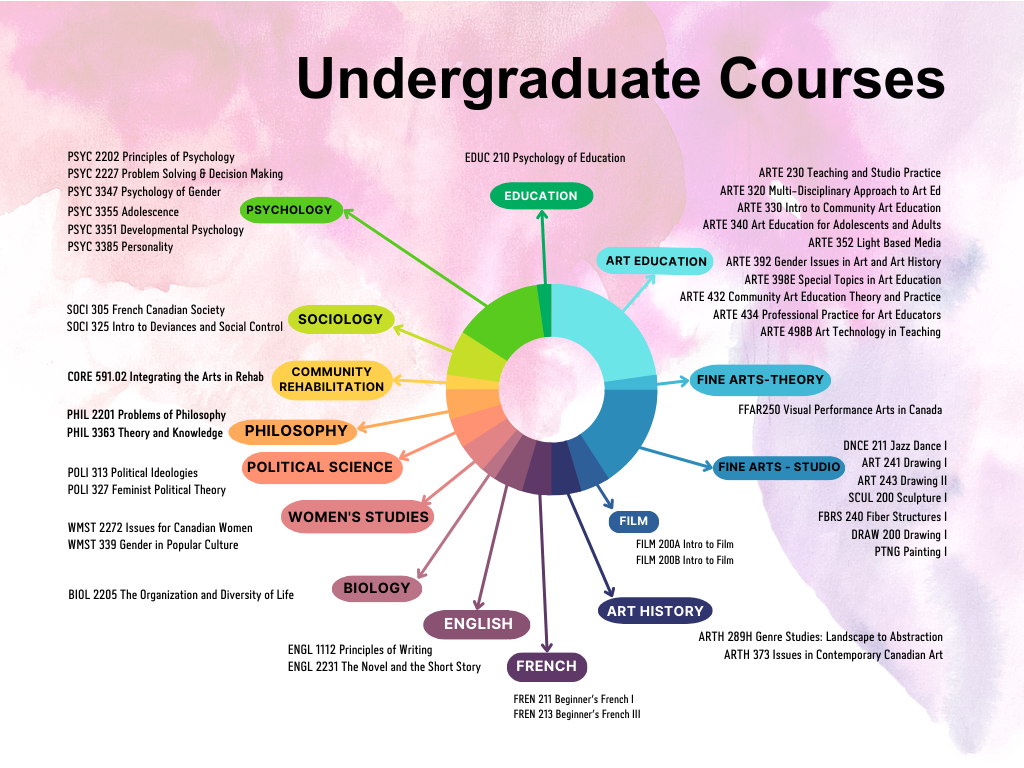
My undergraduate degree in Fine Arts – Art Education from Concordia University focused on the unique relationship between research, creation, and pedagogy. I received solid training in artistic and teaching practices. This is the only school in Canada that offers a BFA in community-based Art Education. With this degree I was able to have a very fulfilling career in exhibit design, planning and curriculum development, and interpretation in community spaces including children’s museums, science centers, galleries, and museums. It helped me fulfill my lifelong goal of using art education as a tool for community development and social change.
I also received a minor in psychology which I gathered while attending University of Calgary and Mount Royal College. This part of my degree asked about child development, educational psychology which helped me develop an understanding about the function of the brain in learning. I was able to gain experience in thinking critically and solving problems, conducting research, analyzing data and communicating effectively. Lastly, I developed skills in information literacy, implementing ethical principles and applying psychological knowledge and skills to personal, social, organizational, and societal problems.
Continuing Education Courses
- Standard First Aid, Canadian Red Cross
- Psychological First Aid, Canadian Red Cross
- AIP2 Planning and Techniques, International Association for Public Participation
- Challenging Conversations Made Easy, MacEwan University, School Of Continuing Education
- Effective Communication Techniques, MacEwan University, School of Continuing Education
- Design Kit: The Course for Human-Centered Design, +Acumen Course in partnership with IDEO.ORG
- AFLCA Group Exercise Certification, Fitness Alberta
- AFLCA Personal Training, Fitness Alberta
- High Five Trainer Certification, High Five
- High Five Sport Certification, High Five
Professional Summary
The following is a summary of some of the skills I gathered throughout my MAIS journey as expressed by ChatGPT. I am including this list because it serves as a clear and concise summary, but also it makes me happy to know that an AI can look at my skills and accomplishments and reflect them back to me in a way that boosts my confidence and I can use when speaking about my MAIS journey as I enter a new career in learning and development.
As a candidate with a diverse set of skills in the learning and development field, I offer a comprehensive range of expertise that can contribute to the success of any organization. My educational background and experiences have equipped me with valuable skills that can effectively support and enhance learning initiatives within an organization.
- Theorizing and Interdisciplinary Thinking: I possess a strong foundation in understanding and applying theoretical perspectives from the humanities and social sciences. This enables me to analyze and interpret complex information, identify relevant theories, and apply them to contemporary issues. Additionally, my interdisciplinary mindset allows me to approach challenges and projects from various angles, promoting integrated learning and problem-solving.
- Program Planning and Evaluation: I have a solid understanding of program planning, evaluation, and instructional methods in adult education. I can effectively assess needs, design educational programs, and evaluate their impact. With a critical perspective and knowledge of diverse models, I can tailor programs to different contexts and apply appropriate instructional methods to ensure effective learning outcomes.
- Labor Education and Social Movements: With a focus on Canadian and international labor education, I have gained insights into the role of education in empowering workers and improving their working conditions. I understand the historical context, theories, and practices of labor education and have explored connections with other social movements. This knowledge allows me to design and deliver culturally relevant, community-responsive labor education programs.
- Interdisciplinary Research: My skills in interdisciplinary research enable me to follow a systematic research process, critically discuss interdisciplinary research approaches, and identify ethical challenges in conducting research. I can develop research questions and proposals for master’s level projects, ensuring high-quality and socially relevant research outcomes.
- Indigenous Knowledge and Education: I have a deep understanding of Indigenous knowledge systems, pedagogies, and worldviews. I can provide cultural context, respect cultural protocols, and apply Indigenous pedagogies to enhance educational experiences for Indigenous and non-Indigenous students. I am also aware of the impacts of colonialism and biases on Indigenous education and can critically analyze and contribute to respectful approaches.
- Adult Education and Community Leadership: I am well-versed in adult education and community leadership theories, connecting them to real-world practices. I can engage in dialogue, analyze social and educational theories, and formulate new perspectives on social issues. My ability to critically reflect on educational and leadership practices allows me to adapt and excel in diverse social contexts.
- Educational Administration and Curriculum Development: I have a strong grasp of educational administration, leadership, and policy. I can analyze the purpose of schooling, understand organizational climate, and contribute to school effectiveness, accountability, and improvement. Additionally, my knowledge of curriculum theories and postmodern perspectives allows me to challenge assumptions, reimagine curriculum, and promote inclusive teaching and learning practices.
- Distance Education and Online Learning: I possess expertise in distance education and online learning, including technology integration, instructional design, and learner support. I am skilled in scholarly writing, research, and reflective practice, as well as utilizing web-based tools and resources. I can contribute to the development and management of distance education programs, ensuring quality and effective online learning experiences.
- Inclusive Leadership and Practice: I am equipped with knowledge and skills to deal with student diversity in educational settings. I understand inclusive education theories, legislation, and policies. I can design inclusive strategies, apply them in the classroom and educational workplace, and advocate for inclusivity. My commitment to creating student-centered and inclusive learning environments enhances student engagement, personal growth, and community building.
Published Works
Talks and Presentations
Delgado, E. 2021. Design Thinking: How a Design Thinker Thinks. Inquiring Minds – Beyond the Classroom Conference June 18 2021, Edmonton Alberta (Presenter)
Delgado, E. 2021. Playful Interactives. Evolution of the Arts in a Digital World Symposium January 20 2021, Edmonton Alberta (Presenter)
Delgado, E. 2020. How to Play with Loose Parts. How To Festival. November 22 2020, Edmonton Alberta (Presenter)
Beck, T, Delgado, E. Kozak, J 2016. Please Touch! Open Ended Program Empower Young Children. Alberta Museums Association Conference, Calgary, Alberta (Co-Presenter)
Delgado, E. Kozak, J. 2015 Designing the Royal Alberta Museum for Young Learners through Human-Centered Design. Alberta Early Years Conference October 2015, Edmonton Alberta (Presenter)
Delgado, E. Durieux, M. What Museums Can Learn From Science Centres. Canadian Museums Association Conference, April 2015, Banff Alberta. (Co-Presenter)
Delgado, E. 2014. Why Edmonton Needs a Children’s Museum. Pechakucha October 2014, Edmonton Alberta (Presenter)
Artefacts
The following artifacts were chosen to showcase my academic journey throughout my MAIS studies. Including how I achieved my academic goals of integrating multidisciplinary and interdisciplinary approaches to a variety of different disciplines, applying critical thought throughout, participating in academic teamwork and creating social awareness through my research.
I begin with a Critical Reflection Essay: “Sonic Warfare and the Politics of Sensation” Which I wrote for MAIS 601 during my first semester. I chose this paper because it highlights a turning point in my understanding of what it means to be a student. Adult Education practice focuses on self directed learning. I had invested interest in this topic and its articulation helped me to understand where I can excel as a student. It also taught me how important the connection between student and subject matter is to the success of the student.
The second artifact I chose was my final project for MAIS 642: Final Project: “Adult Learning Project: Happiness for Retirees”. This project highlights my skills as an adult learning professional. I had been working as a program developer for many years and it was a nice exercise to revisit the planning process, breaking each step one by one. I enjoy the theme of this project, but I over planned. Now that I have the chance to reflect on my work I see where I can improve. The content of the class, playfulness, and happiness are concepts which were reviewed throughout my MAIS journey. These are important socially relevant topics, and their interrogation can benefit countless people.
Next was my final project in MAIS 602: “Play and Playfulness Pedagogy in Museum learning spaces for Adult Audiences”. This paper looked at the role of play as a tool for engaging adults in museum settings. The purpose of this project was to justify the methodologies I intend to use in my research and the ethical challenges I may encounter and how I would hope to mitigate them. Interrogating the research process and addressing a variety of methodology was an important exercise which I continued to revisit throughout my MAIS journey. I also revisited the topic of play pedagogy, finding new sources of intrigue.
The fourth artifact is my final research paper for INST 511: “Using Indigenous Picture Books to Connect to Indigenous Ways of Knowing”. I used my background in child development, early literacy, and early learning to approach difficult and challenging topics. I chose this artifact because I believe that the content of the paper would have benefited from a different presentation.
Next is my final paper for MDDE 601, Literature review of corporate e-Learning. I chose this artifact because it highlighted an important turning point in my academic studies and in my professional career. This project helped me understand the integration of workplace e-learning including evaluation, which is one of the most important facets of programming. This project also helped me to realize how confident I was becoming as a student.
The sixth artifact is an argument paper that I wrote for MDDE 631, Democratic Leadership as the Foundation for Inclusive Education. I interrogated my leadership style throughout my MAIS journey including MAIS 642, MAIS 644, EDST 646 and MDDE 631. I chose this artifact because not only does it demonstrate my in-depth analysis of Democratic Leadership style, and how it is directly applicable to my own leadership style. This is a major revelation for me as an Educator, and will serve me well throughout my career.
The seventh and last artefact is the final paper for EDST 645: “Expression and Embodiment of Emotions in Learning”. This paper allowed me to bring together knowledge from psychology, neuroscience, and education. I was able to address and explore the complex role that emotions play in learning, especially workplace learning. When I began my studies, I had looked at play and playfulness and their role in learning, but by the end of my studies I realized that all emotions are valid and their role in workplace learning is a complex one.

Artefact 1
Critical Reflection Essay
Sonic Warfare and the Politics of Sensation
MAIS 601: Making Sense of Theory in the Humanities and Social Sciences
December 6 2021
Artefact 2
Final Project
Adult Learning Project: Happiness for Retirees
MAIS 602: Doing Interdisciplinary Research
December 18, 2021
Artefact 3
Final Project: Research Question, Proposal and Reflection
Play and Playfulness Pedagogy in Museum Learning Spaces for Adult Audiences
MAIS 602: Doing Interdisciplinary Research
April 24, 2022
Artefact 4
Final Project
Using Indigenous Picture Books to connect to Indigenous Ways of Knowing
INST 511: Indigenous Knowledge and Education
June 3 2023
Artefact 5
Final Project
Literature Review of Corporate e-Learning
MDDE 601: Intro to Distance Education and Training
December 4, 2020
Artefact 6
Argument Paper
Democratic Leadership as the Foundation for Inclusive Education
MDDE 631: Inclusive Leadership and Practice in Education
February 12 2023
Artefact 7
Final Term Paper
Expression and Embodiment of Emotions in Learning
EDST 645 Curriculum: Provoking Inquiry
May 2 2023
Conclusion
I had begun my MAIS journey with many personal, academic, and professional goals. I reflected on myself as a student and as I advanced through my MAIS journey, I noticed that challenges in research, interrogation, time management and articulation became easier to overcome. By confronting the challenges I faced as a student, I also grew as an educator. I began to gather educational methodology to add to my professional practice and I broke down the planning model and addressed it through a variety of different viewpoints. I looked at deficits in my knowledge around inclusive learning practices and Indigenous education methods and my new knowledge and practice now influences all areas of my professional self. One of the research questions that I carried throughout my journey was to uncover the role of happiness in learning. As I advanced through my studies, I looked at this issue through a variety of disciplines, methods and locations. I was successful in expanding my curiosity beyond happiness and looking at the role of all emotions in learning, particularly workplace learning.
I thought that I would continue to revisit the concept of emotions and learning for my capstone project. I continued to have that goal until the course was well underway. However, to move past being a student and reaching my graduation goals, I also had some personal goals. I needed to reflect on myself as a student -particularly the issue of my severe anxiety brought on by the covid pandemic, restarting my academic career after so many years, and finally having the confidence, the knowledge, and the skills to transition to a new career. I feel that to achieve those personal goals, I needed to reflect on the reasons why the topic of emotions was so important to me. I also needed to understand myself as an educator. I have been teaching for many years, but all the locations were very similar – alternative learning institutions that encourage play as a tool for learning. Transitioning to corporate learning meant that I needed a strong theoretical foundation, and a strong practical foundation which showcased putting theory to practice. The second major research for me was about having a deep understanding about what my leadership style is and being able to apply it to inclusive learning practices. The autoethnographic research involved in creating my e-portfolio allowed me to do that. I am now a capable student who understands interdisciplinary research and I am a confident democratic leader who applies inclusive learning practices in everything I do.